Critical Thinking
Critical thinking is the ability to objectively analyze information, evaluate evidence, and make reasoned judgments to guide decision-making. It involves questioning assumptions, identifying biases, and considering multiple perspectives before reaching conclusions. According to Peter Facione, critical thinking includes skills such as interpretation, analysis, evaluation, inference, and explanation, all of which contribute to sound reasoning. This competency is essential in complex environments where leaders must process large amounts of information and determine the most effective course of action. Ultimately, critical thinking allows individuals to move beyond surface-level understanding and make decisions that are both logical and well-informed (Facione, 1990).
Reference: Facione, P. A. (1990). Critical thinking: A statement of expert consensus for purposes of educational assessment and instruction (The Delphi Report). American Philosophical Association.
Critical Thinking in a Leader
Critical thinking strengthens my ability to lead by enabling me to assess situations more thoroughly and make informed decisions under pressure. It allows me to break down complex problems, identify root causes, and evaluate potential solutions before taking action. As a leader, this competency helps me avoid reactive decision-making and instead approach challenges with a strategic and thoughtful mindset. It also improves my ability to ask the right questions, challenge assumptions and guide my team toward more effective outcomes. By applying critical thinking, I am better equipped to balance risks, anticipate obstacles, and ensure that decisions align with both short-term needs and long-term goals.
Critical Thinking and My Degree
It is important for professors to include critical thinking as a competency within the Organizational Leadership degree because leaders are constantly required to navigate complex and uncertain situations. Without strong critical thinking skills, leaders may rely on assumptions or incomplete information, which can lead to poor decision-making. Developing this competency prepares students to analyze problems more deeply, consider multiple perspectives, and make decisions that are both strategic and ethical. It also encourages independent thinking, which is essential for adapting to changing organizational environments. By emphasizing critical thinking, the program ensures that future leaders are equipped to handle challenges with confidence, clarity, and sound judgment.
My Growth at ASU
During my time at ASU, I have developed my critical thinking skills through coursework that required deeper analysis, problem-solving, and reflection. Early on, I often approached assignments with a focus on completing the task, but over time I learned to evaluate information more critically and consider the broader implications of my decisions. Through case studies, projects, and discussions, I became more comfortable questioning assumptions and exploring multiple solutions before forming conclusions. This growth has improved my ability to think strategically and approach challenges with a more analytical mindset. Overall, my experience at ASU has strengthened my confidence in making thoughtful, well-reasoned decisions as a leader.
My Artifact
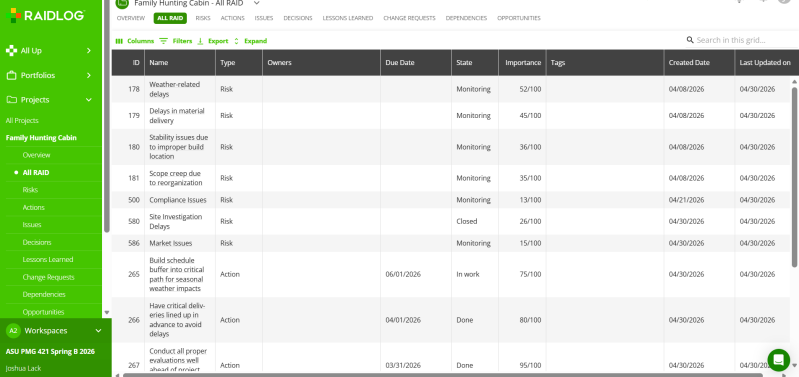
My competency artifact is a RAIDLog that I created for a course project, where I analyzed a real-world scenario involving a family hunting cabin. The project required me to break down the project timeline, identify potential risks, assumptions, issues, and dependencies, and evaluate the possible outcomes associated with each. This artifact directly connects to critical thinking because it required me to assess multiple variables, anticipate challenges, and make informed judgments about how different risks could impact the project. Additionally, I reflected on lessons learned, which helped me evaluate what could be improved in future situations. Overall, this artifact demonstrates my ability to apply critical thinking in a practical setting by analyzing complex factors and making strategic, well-informed decisions.